


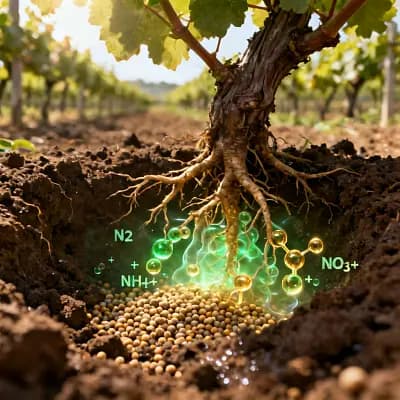
Physiological Basis of Spring Plant Nutrition: Why Early Nitrogen Application Is Ineffective and Potentially Harmful
With the onset of the spring season, gardeners and farmers are often tempted to immediately supply plants with readily available nitrogen. The logic behind this is intuitive: green biomass growth requires building material. However, plant physiology data indicate that such early stimulation not only fails to provide the expected benefit but may also trigger a cascade of negative metabolic consequences.
🛡️ Survival Strategy: Mobilization of Endogenous Resources
At the initial stage of vegetation, while the soil has not warmed up to biologically active temperatures (+10 °C), the root system of perennial crops functions in a limited mode. The formation of new root hairs and active ion transport through the rhizodermis are inhibited.
During this period, the plant relies exclusively on the remobilization of stored nutrients deposited in the cortex, pith, and rhizomes during the previous season.
Energy and plastic metabolism at this moment are directed toward a single priority: the expansion of the leaf’s photosynthetic surface. Any diversion of resources to process external inputs, in the absence of полноценного source–sink interaction between organs, leads to a reduction in growth rates.
⚠️ Biochemical Trap: Nitrogen Without Substrate
The application of mineral nitrogen fertilizers (nitrate or ammonium forms) in cold soil triggers premature activation of root enzyme systems. However, for the conversion of inorganic nitrogen into organic compounds—amino acids and subsequently structural proteins—a number of strict conditions must be met.
Carbon Skeleton Deficiency
The amination reaction (incorporation of nitrogen into an organic molecule) requires the presence of keto acids formed during photosynthesis (Calvin cycle) and respiration. Since the photosynthetic apparatus of the leaf is not yet developed at the bud-break stage, the plant is forced to use limited carbohydrate reserves from storage organs. This leads to the diversion of plastic substances from growth meristems to sites of excess nitrogen metabolism.
Lack of Accompanying Macronutrients
Protein synthesis critically depends on the presence of sulfur (as part of the amino acids methionine and cysteine) and phosphorus (as part of ATP macroergic bonds and nucleic acids). Under low temperatures, the availability of phosphates sharply decreases due to passive diffusion in the soil solution, while the activity of soil microbiota responsible for mineralizing organic sulfur and phosphorus compounds remains minimal.
⚡ Consequences of Imbalanced Mineral Nutrition
Due to the inability to immediately incorporate absorbed nitrogen into structural metabolism, it is temporarily sequestered in cell vacuoles in the form of nitrates or amides. This phenomenon is associated with two significant risks:
🦠 Reduced Phytoimmunity
High levels of free nitrogenous compounds in tissues alter the osmotic pressure of cell sap and increase the proportion of non-structural carbohydrates. Such tissues become more susceptible to penetration by pathogenic fungal hyphae and serve as an attractant for piercing-sucking pests (aphids, mites).
❄️ Reduced Cryoresistance
Excessive nitrate accumulation increases cytoplasmic hydration and thins the cell wall, raising the risk of tissue damage during late spring frosts.
📅 Recommendations on Timing of Agronomic Interventions
Thus, early application of nitrogen fertilizers represents an inefficient use of resources, leading to an imbalance in metabolic flows. From a plant physiology perspective, the optimal moment for the first fertilization is the phase of full leaf blade expansion and the onset of active transpiration flow.
By this time:
✅ The soil warms to levels that activate the growth of absorbing roots and rhizosphere microflora.
✅ Normal photosynthesis is restored, providing the necessary influx of carbon skeletons for nitrogen assimilation.
✅ Soil phosphorus becomes available.
Before this phenological phase, the most rational agronomic practices are those aimed at improving soil aeration (loosening) and conserving moisture, which indirectly stimulates the natural development of the root system without interfering with the delicate regulation of plant growth processes.
💧 Practical Recommendation
During this period, when fertigation is available, an effective approach is the application of “Foliart Riza” at a rate of 4 L/ha, which promotes stimulation of root system activity. 🌿
🧬 Physiological Basis of Spring Plant Nutrition: Why Early Nitrogen Application Is Ineffective and Potentially Harmful
With the onset of the spring season, gardeners and farmers are often tempted to immediately supply plants with readily available nitrogen. The logic behind this is intuitive: green biomass growth requires building material. However, plant physiology data indicate that such early stimulation not only fails to provide the expected benefit but may also trigger a cascade of negative metabolic consequences.
🛡️ Survival Strategy: Mobilization of Endogenous Resources
At the initial stage of vegetation, while the soil has not warmed up to biologically active temperatures (+10 °C), the root system of perennial crops functions in a limited mode. The formation of new root hairs and active ion transport through the rhizodermis are inhibited.
During this period, the plant relies exclusively on the remobilization of stored nutrients deposited in the cortex, pith, and rhizomes during the previous season.
Energy and plastic metabolism at this moment are directed toward a single priority: the expansion of the leaf’s photosynthetic surface. Any diversion of resources to process external inputs, in the absence of полноценного source–sink interaction between organs, leads to a reduction in growth rates.
⚠️ Biochemical Trap: Nitrogen Without Substrate
The application of mineral nitrogen fertilizers (nitrate or ammonium forms) in cold soil triggers premature activation of root enzyme systems. However, for the conversion of inorganic nitrogen into organic compounds—amino acids and subsequently structural proteins—a number of strict conditions must be met.
Carbon Skeleton Deficiency
The amination reaction (incorporation of nitrogen into an organic molecule) requires the presence of keto acids formed during photosynthesis (Calvin cycle) and respiration. Since the photosynthetic apparatus of the leaf is not yet developed at the bud-break stage, the plant is forced to use limited carbohydrate reserves from storage organs. This leads to the diversion of plastic substances from growth meristems to sites of excess nitrogen metabolism.
Lack of Accompanying Macronutrients
Protein synthesis critically depends on the presence of sulfur (as part of the amino acids methionine and cysteine) and phosphorus (as part of ATP macroergic bonds and nucleic acids). Under low temperatures, the availability of phosphates sharply decreases due to passive diffusion in the soil solution, while the activity of soil microbiota responsible for mineralizing organic sulfur and phosphorus compounds remains minimal.
⚡ Consequences of Imbalanced Mineral Nutrition
Due to the inability to immediately incorporate absorbed nitrogen into structural metabolism, it is temporarily sequestered in cell vacuoles in the form of nitrates or amides. This phenomenon is associated with two significant risks:
🦠 Reduced Phytoimmunity
High levels of free nitrogenous compounds in tissues alter the osmotic pressure of cell sap and increase the proportion of non-structural carbohydrates. Such tissues become more susceptible to penetration by pathogenic fungal hyphae and serve as an attractant for piercing-sucking pests (aphids, mites).
❄️ Reduced Cryoresistance
Excessive nitrate accumulation increases cytoplasmic hydration and thins the cell wall, raising the risk of tissue damage during late spring frosts.
📅 Recommendations on Timing of Agronomic Interventions
Thus, early application of nitrogen fertilizers represents an inefficient use of resources, leading to an imbalance in metabolic flows. From a plant physiology perspective, the optimal moment for the first fertilization is the phase of full leaf blade expansion and the onset of active transpiration flow.
By this time:
✅ The soil warms to levels that activate the growth of absorbing roots and rhizosphere microflora.
✅ Normal photosynthesis is restored, providing the necessary influx of carbon skeletons for nitrogen assimilation.
✅ Soil phosphorus becomes available.
Before this phenological phase, the most rational agronomic practices are those aimed at improving soil aeration (loosening) and conserving moisture, which indirectly stimulates the natural development of the root system without interfering with the delicate regulation of plant growth processes.
💧 Practical Recommendation
During this period, when fertigation is available, an effective approach is the application of “Foliart Riza” at a rate of 4 L/ha, which promotes stimulation of root system activity. 🌿